In a rapidly changing digital world, we are faced with a familiar yet increasingly pressing dilemma:
Time
Many of us wonder:
“How can I maximize the limited time I have to learn and practice what I love ?”
This reflection leads us to a futuristic and fascinating question:
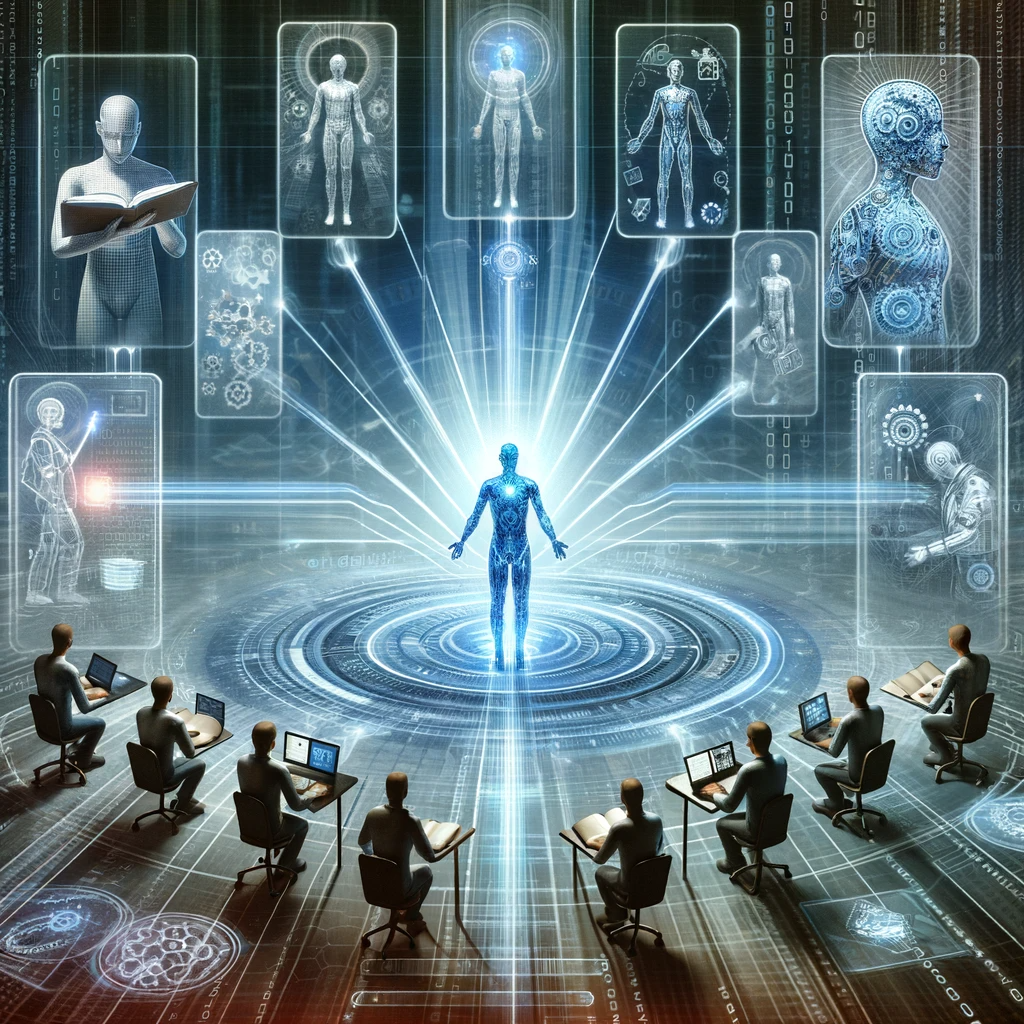
Could it be possible, in the not-too-distant future, to replicate ourselves in digital environments to accelerate our learning process ?
Once relegated to the realm of science fiction, this idea is beginning to seem less fantastical and more achievable, considering the speed with which technology is advancing.

The article you are reading is inspired by the revolutionary TEDx talk given by Jim Fan, a renowned researcher in the field of artificial intelligence (Nvidia AI).
Here is the link if you are interested:
In his talk titled “The Next Grand Challenge for AI” Jim Fan presents what he defines as the “foundation agent” a cutting-edge concept that aims to seamlessly blend the virtual world with the physical one.
According to this researcher, this technology has the potential to radically transform our daily lives, finding applications in areas ranging from video games and metaverses to drones and humanoid robots.
The idea of a single model capable of mastering skills in different realities opens new horizons and raises stimulating questions, especially in terms of learning and personal development.

The concept of the “Foundation agent” presented by Jim Fan concerns the development of a new type of artificial intelligence that operates effectively in both the virtual and physical worlds. This approach aims to create a unified AI model that can acquire and apply skills in a variety of different contexts, surpassing the limits of current artificial intelligence systems that are generally specialized for specific tasks or environments.

The idea is that a “foundation agent” can learn and adapt through a wide range of scenarios, from navigating physical environments, like piloting drones or controlling humanoid robots, to interacting in virtual worlds, like metaverses or video games.
This means the same AI agent could, for example, learn to play chess, manage a smart home, and participate in medical training simulations, all with the same basic set of skills. Extending this concept, the foundation agent could represent a significant step towards the creation of more versatile and comprehensive AI systems, which could be used for a variety of practical applications, from healthcare to education, to entertainment.

In the context of our article, exploring the foundation agent raises fascinating questions about digital replication and learning.
If a foundation agent can operate in different environments and learn a variety of tasks, could this approach be used to create digital versions of ourselves ?
These digital replicas could, in theory, learn and perform tasks on our behalf, potentially expanding our way of interacting with the world and accelerating our learning process.
Currently, technology is not yet advanced enough to allow for a digital replication of a person’s consciousness or personality so that it can learn autonomously.
However, there are some technological and conceptual developments that I believe are worth considering in this context:
Virtual Reality and Augmented Reality: Immersion in Learning
Virtual reality (VR) and augmented reality (AR) are revolutionizing the way we learn and interact with the digital world. These technologies offer an immersive environment that can simulate real or fantastic scenarios, providing fertile ground for experiential learning. From medical training to machinery repair, VR and AR allow us to acquire practical skills in a safe and controlled environment.
Artificial Intelligence: Virtual Assistants for Personalized Learning
Artificial intelligence (AI) plays a crucial role in adapting the learning experience to individual needs. AI agents can analyze an individual’s learning style and adjust content accordingly, providing a highly personalized experience.
This not only improves the efficiency of learning but can also help maintain engagement and motivation.
Educational Games and Simulations: Learning through Play
Educational games and simulations offer a dynamic and interactive approach to learning. Through play, users can explore complex concepts, experiment with decisions and outcomes, and learn in a way that is both effective and fun. These tools make learning more accessible and can be particularly effective in engaging young minds.
Digital Cloning: A Possible Future ?
Digital cloning, although still in its embryonic stage, represents a fascinating idea. The goal is to create a digital avatar that not only resembles an individual but can also imitate their way of thinking and learning. However, this raises complex issues related to ethics, identity, and consciousness. The possibility of cloning human consciousness remains, at the moment, a futuristic ambition.
Neuroscience and Brain-Computer Interfaces: Amplifying Human Learning
Neuroscience, combined with brain-computer interfaces, could offer ways to optimize the functioning of the human brain. Although still in its early stages, this research could one day allow for the improvement of learning ability, perhaps even allowing skills to be directly downloaded into the brain. Yesterday saw the first Neuralink implant in a man.
Conclusion:
Imagine a future where your learning potential is multiplied, where every new skill is within reach of a digital version of yourself.
This vision, once relegated to dreams, is now an increasingly tangible horizon thanks to advances in VR, AI, and neuroscience.
How would you feel if you could explore and master new skills with unprecedented ease and speed?
Now, as you move towards this future, consider how you might use these emerging technologies to overcome your current learning limits.
I invite you to reflect:
how might you integrate these innovations into your life or career ?
And more importantly, what impact could these technologies have on the way we live, work, and learn?
The road ahead of us is open and full of possibilities.
The question I leave to you is: how will you choose to travel it ?
Thank you very much for reading,
Luca
if you want to stay on touch with me:
https://www.linkedin.com/in/lucacarraro88/
https://www.youtube.com/@JamesLupin
https://www.instagram.com/ilbioss/
#DigitalLearning #VirtualReplication #FuturisticTechnology #KnowledgeTransfer #DigitalAvatars #VirtualEnvironment #InnovativeEducation #HumanComputerInteraction #jimfan #nvidiaai #LearningAcceleration #VirtualRealism
 Ilbioss's Blog